
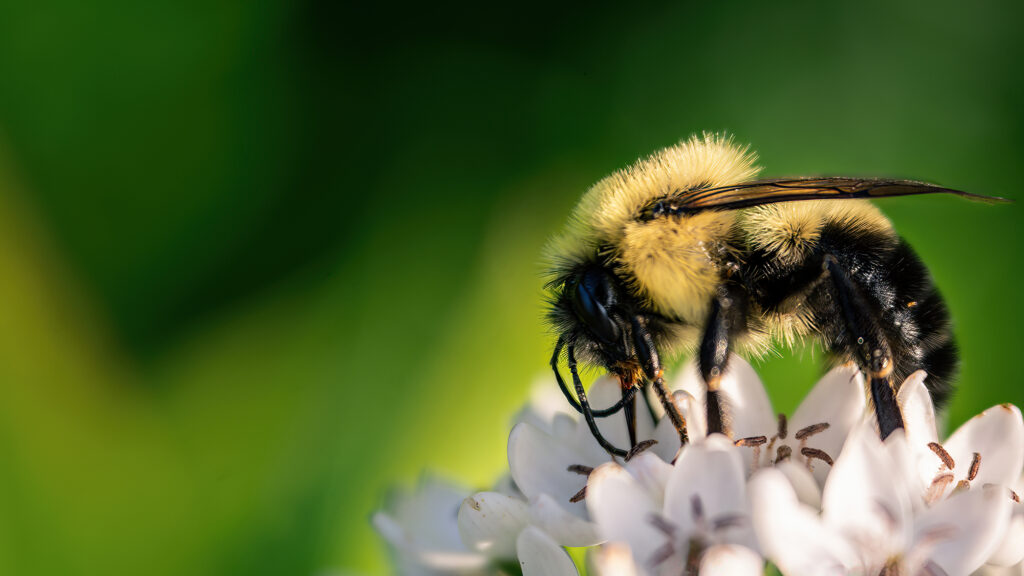
If you have ever watched a bee at work at a flower, mysteriously moving around and then lifting off again dusted in gold, you have witnessed a wondrous partnership. Bees and flowering plants have been co-evolving for tens of millions of years, shaping each other’s physical forms, behaviors, and futures. Today, that partnership underpins much of the food we eat, the ecosystems we depend on, and the wildflowers we love. Understanding how this partnership works and why it is under threat is more important now than ever.
What is Pollination?
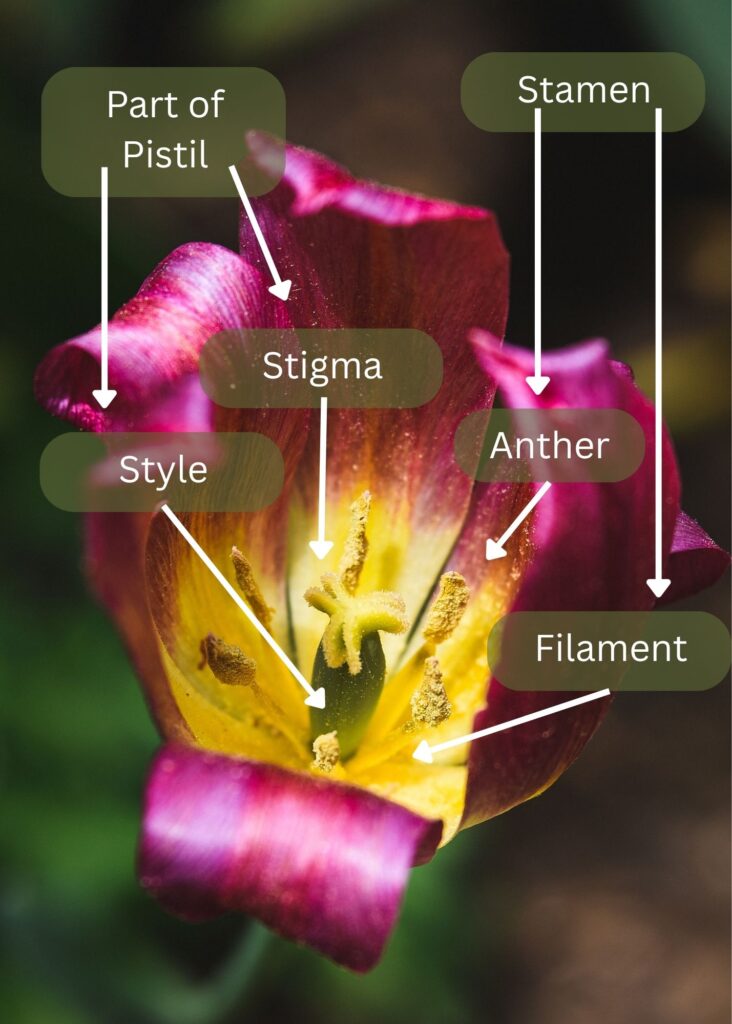
Pollination occurs when pollen, tiny grains that contain the male gametes of a plant, is transferred from the anther, where pollen is produced, to the stigma of a plant. From there, the pollen travels down to the ovary, where fertilization can occur. The fertilized ovule becomes a seed; the ovary wall becomes the fruit. That apple, that almond, that squash on your kitchen counter all began with this nearly imperceptible transfer.
Plants can pollinate themselves in a process called self-pollination but most flowering plants have evolved to favor cross-pollination, where pollen from one plant fertilizes another of the same species. Cross-pollination produces greater genetic diversity, which makes plant populations more resilient. Some species can even cross-pollinate between related species, producing hybrids.
Pollinating Agents
Pollinating agents can be abiotic, such as wind and water, or biotic, such as insects, birds, bats, or even other plants. Wind pollination is an ancient method of pollination, highly effective for plants like grasses and conifers, which produce enormous quantities of lightweight pollen. Think of the green “dust” in the air, on your cars, and, if you were unlucky enough to forget to close your windows, all over your house for a few weeks in the spring. But biotic pollination, particularly by insects, is more targeted and efficient.
Entomophily, or pollination by insects, has been happening since the age of the dinosaurs. Fossil evidence suggests that insect pollination was underway at least 100 million years ago, when flowering plants (angiosperms) first began their remarkable diversification. The most familiar insect pollinators are bees, wasps, butterflies, moths, and beetles, though flies are surprisingly important too — they are responsible for pollinating cacao, the plant that gives us chocolate.
Agent B006: The Bee
Bees are familiar pollinating agents. Not only have most of us observed them busily visiting flowers in gardens, parks, fields, and forests, but many of us enjoy a delicious byproduct of their efforts — honey. However, honey really isn’t the most important output of their labor. Far more significant is the fertilization of plants that produce the fruits, nuts, seeds, and vegetables that sustain ecosystems and fill our stores and shelves.
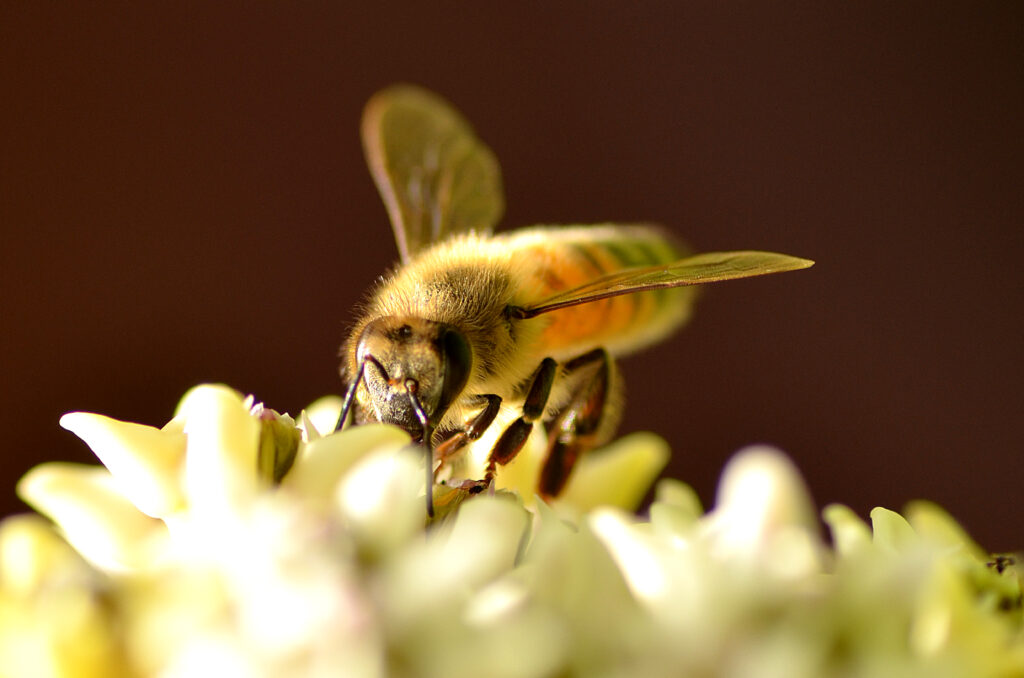
Although far from a settled question, one study (Klein et al., 2007) found that roughly 35% of global food production crops relies on animal pollinators — though it is worth noting that this figure includes all animal pollinators, not bees alone. Regardless of the actual number, it’s clear that bees matter to many of the crops we value for nutrition and flavor: fruits, vegetables, nuts, and many oilseeds.
Consider almonds: California’s almond orchards, which supply the majority of the world’s almonds, require managed honeybee colonies for pollination on a massive scale. Blueberries, cherries, avocados, and many other crops are similarly reliant on bee pollination. But bees do not pollinate only for our benefit. Long before humans arrived, bees were essential partners for wild plants, and the fruits and seeds they help produce feed birds, mammals, and other insects. Remove bees from an ecosystem and you do not simply lose a pollinator — you begin to unravel a food web.
A Short History of the Bee
To understand bees, it helps to know where they came from. The current scientific thinking is that bees evolved from predatory wasps, specifically, a group related to modern crabronid wasps, sometime in the Cretaceous period, roughly 130 million years ago. At some point, these ancestral wasps made a remarkable dietary shift: instead of hunting insects and other arthropods to feed their larvae, they switched to collecting pollen and nectar.
Why this shift occurred is still being debated, but one hypothesis is that pollen was accidentally introduced into the nest when wasps hunted pollen-feeding beetles. Gradually, pollen became the primary food source. This dietary change drove an extraordinary transformation in body form: the sleek, predatory wasp body gave way to the fuzzy, pollen-trapping bee body we know today.
A Story of Co-Evolution
Mutual Benefits: Pollen and Nectar
The relationship between bees and flowering plants is a great example of mutualism, a relationship where both parties benefit. Plants provide bees with food; bees provide plants with the service of pollination. But this relationship goes far deeper than a simple transaction. Over millions of years, bees and flowers have shaped each other, evolving in tandem in ways that are sometimes astonishing.
Flowers attract bees primarily through two rewards: nectar and pollen. Nectar is a sugary liquid produced by glands called nectaries, usually found at the base of the flower. Nectar is a fuel source that bees convert to honey. Pollen, by contrast, is protein-rich and is used primarily to feed larvae. It is, nutritionally speaking, bee baby food.
But flowers do not simply sit and wait for bees and other pollinators. They have evolved a remarkable toolkit for attracting and directing their pollinator partners. Flower color is a key signal; because bees see in a spectrum shifted toward ultraviolet light, they can detect UV patterns on petals that are invisible to humans. Many flowers have UV “nectar guides”, patterns that function like runway lights, directing bees straight to the pollen and nectar. What looks like a plain yellow flower to us may appear to a bee as a boldly patterned landing pad.
Flower shape is equally important. Some flowers have evolved to fit their pollinators almost perfectly (just as pollinators have evolved to fit “their” flowers!). The long, tubular shape of certain flowers favors long-tongued bees; wide, open flowers with flat landing platforms welcome short-tongued generalists. The snapdragon flower is so tightly closed that only bees heavy enough to pry it open can access its interior, a clever way of ensuring that only the best matched pollinators get the reward.
Fragrance is another powerful attractant. Many flowers produce complex scent compounds specifically tuned to the olfactory systems of their target pollinators. Some orchids have evolved flowers that mimic the appearance and even the chemical scent of female bees, inducing male bees to attempt mating with the flower and inadvertently picking up pollen in the process, a strategy that is just pure deception.
The Electric Connection
One of the most remarkable recent discoveries in pollination biology concerns static electricity. As bees fly through the air, friction with charged particles causes them to accumulate a positive electrostatic charge. Flowers, meanwhile, are grounded through the earth and tend to carry a slight negative charge. When a positively charged bee approaches a flower, the opposing charges attract — and pollen can actually leap from the flower onto the bee before the bee even lands.
In 2013, researchers at the University of Bristol (Clarke et al., 2013; Clarke et al., 2017) confirmed something even more astonishing: bumblebees can sense and learn from floral electric fields. The bees could distinguish between artificial flowers with different electric field geometries, using this invisible information alongside color and scent to find nectar. A follow-up study in 2016 (Sutton et al., 2016) found that the tiny mechanosensory hairs on a bee’s body act as sensing organs, physically deflecting in response to electric fields and so sending signals to the bee’s nervous system. The field of bees and flowers, it turns out, is quite literally electric.
Bee Anatomy: Built for Pollen
No creature on Earth is better designed for collecting pollen than a bee. From the tips of their antennae to the ends of their legs, bees are built around the task of finding, gathering, and transporting pollen.
The Hairy Body
The most obvious bee adaptation is also the most fundamental: fuzziness. Bee hairs, or setae, are not smooth like mammalian hair. Under a microscope, they are branched or plumose, resembling tiny feathers or bottle brushes. This branching structure creates an enormous surface area that both electrostatically attracts pollen grains and physically traps them when a bee makes contact. The combination of electrostatic attraction and these textured hairs makes the bee an extraordinarily effective pollen collector.
Fuzzy Legs and Pollen Baskets
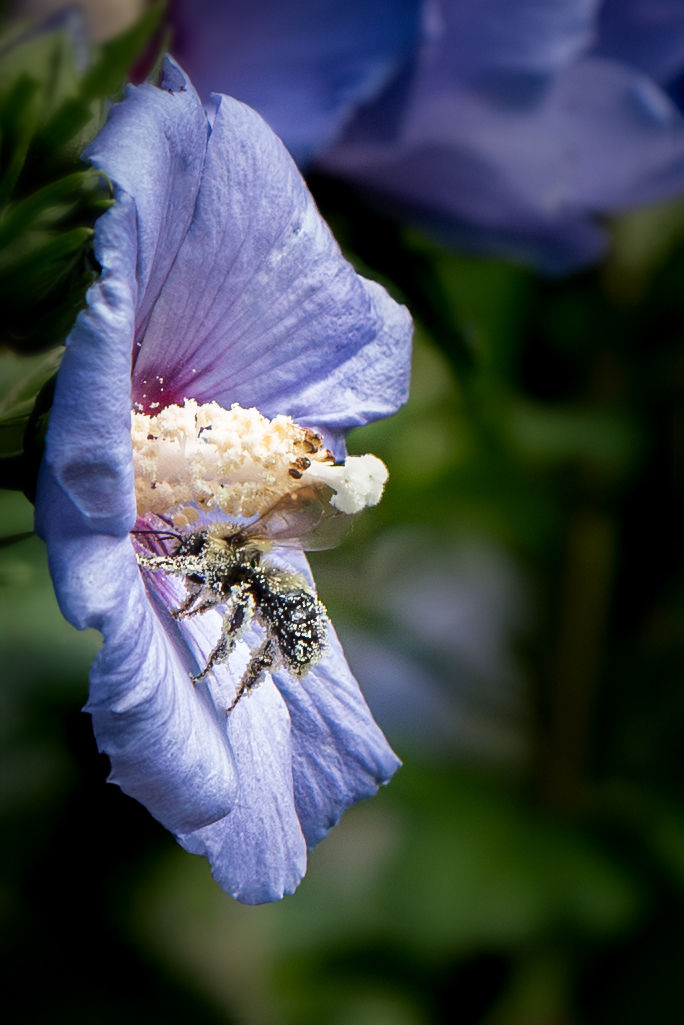
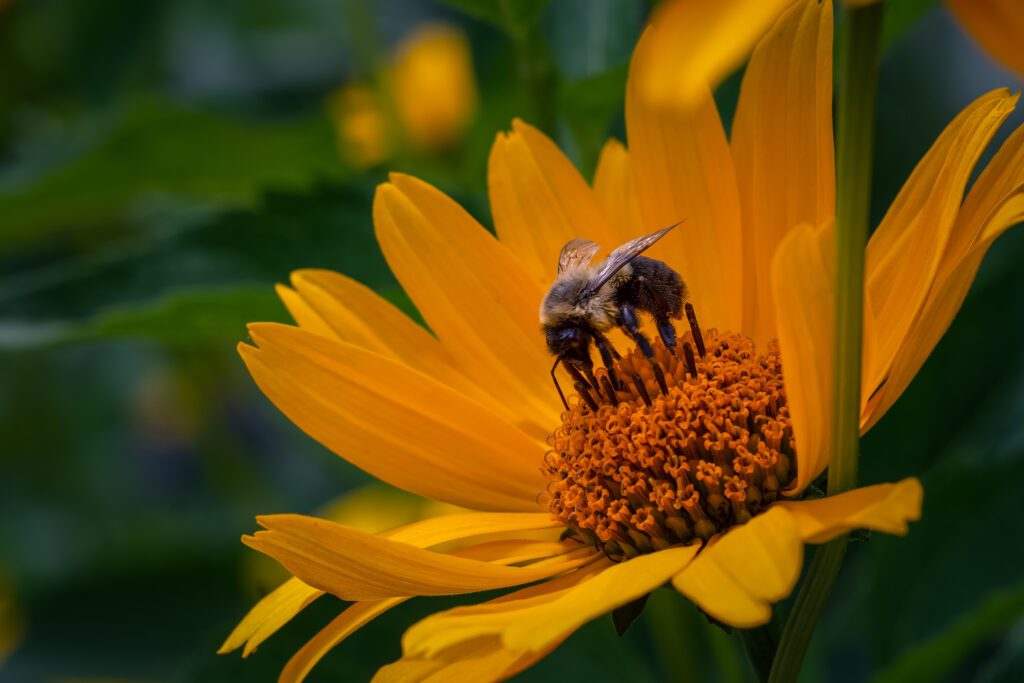
A bee’s fuzzy legs and, in some cases, abdomens are thick with these specialized hairs, areas called scopae which collect and store pollen. But scopae are not the only way a bee stores pollen as she travels from flower to flower; some species of bees, like the familiar bumblebee and honeybee, have corbiculae, indented spots on their legs surrounded by curved hairs that can hold large clumps of pollen. As their legs become covered with pollen, bees with corbiculae groom their legs, gathering grains of pollen mixed with saliva and nectar into tightly packed packages which are tidily stowed in the corbiculae. You may have noticed bumblebees with large, yellow saddlebags on their back legs; these “pollen baskets” are the corbiculae packed with pollen packages ready for transport back to the hive.
But no matter how good their pollen management, some pollen falls from the hairy embrace of the scopae and corbiculae, beginning the process of fertilization at each flower the bee visits.
The Hairy-Footed Flower Bee: A Case Study
Found mainly in Europe and Asia, the Hairy-Footed Flower Bee (Anthophora plumipes), the subject of David Perkins’ delightfully named and beautifully illustrated book, “Hairy-Foot, Long-Tongue: Solitary Bees, Biodiversity, and Evolution in Your Backyard”, is an example of this specialized bee anatomy. True to its name, the male of this species has conspicuous tufts of hair on its middle legs, likely used in courtship. However, the female Hairy-Footed Flower Bee is the industrious forager, gathering nectar from flowers with her long tongue and collecting pollen along the way on the hairs on her legs and abdomen. Unlike many bee species, the Hairy-Footed Flower Bee does not have a pollen basket or other special “accessories” to hold the collected pollen; rather her scopae collects and stores the pollen as she visits flower after flower, busily finding food for her future eggs.
Side note that must be mentioned: the Hairy-Footed Flower Bee also has a notably long proboscis relative to its size, allowing it to reach deep into tubular flowers. One of its favorite early-spring food sources is lungwort (Pulmonaria), a relationship that makes it a vital early-season pollinator when few other bees are active.
The Proboscis: Reaching for Nectar
Speaking of bee tongues, a bee’s proboscis is not a hollow straw but full of grooved, hairy structures that draw nectar up by capillary action. Tongue length varies enormously across species. Short-tongued bees like sweat bees can only access open, shallow flowers. Long-tongued bees like bumblebees can reach deep into tubular flowers, a beautiful example of form following function in the co-evolutionary arms race between bees and plants.
The Lifecycle of a Bee
There are roughly 20,000 known species of bees worldwide, and they vary considerably in their social organization, nesting habits, and lifecycles. Most people think of bees as social insects living in large colonies — this is the honeybee model. But the vast majority of bee species are solitary. A solitary female bee mates, finds a nesting site (often a hole in the ground or a hollow stem), provisions individual cells with a ball of pollen and nectar, lays an egg on it, seals the cell, and leaves. She will never meet her offspring.
Social bees, including honeybees, bumblebees, and stingless bees, live in colonies with a queen, workers, and drones. Bumblebee colonies are annual: a mated queen overwinters alone, founds a new colony in spring, and the whole colony (except new mated queens) dies in autumn. Honeybee colonies are perennial, surviving winter as a cluster, relying on stored honey for energy and the warmth of each other to stave off the cold.
Bee Species: More Than Honeybees
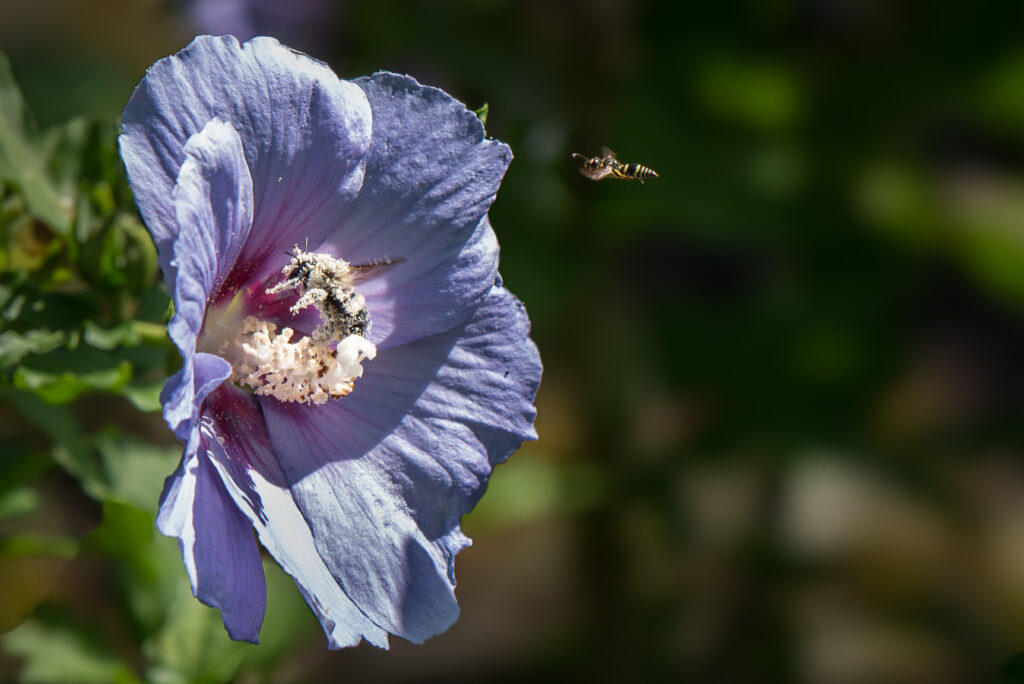
When most people think of bees, they picture the European honeybee (Apis mellifera). But honeybees are not native to North America; they were introduced by European colonists in the early 17th century. North America has its own extraordinarily rich native bee fauna, with over 4,000 native bee species including bumblebees, mason bees, sweat bees, leafcutter bees, mining bees, and many others that were pollinating North American plants long before the first honeybee arrived.
This matters because native bees are often more effective pollinators of native plants than honeybees. The southeastern blueberry bee (Habropoda laboriosa), for instance, is regarded as the most efficient pollinator of southern rabbiteye blueberries. It uses a technique called buzz pollination (or sonication) where the bee latches onto the flower and vibrates its flight muscles at 100 to 500 Hz to shake loose pollen that blueberry flowers hold tightly (Sampson & Cain, 2000). Honeybees cannot produce these vibrations. Tomatoes, peppers, eggplants, and kiwis are similarly dependent on buzz pollinators; over half of all native bee species can perform buzz pollination, while honeybees cannot (De Luca & Vallejo-Marín, 2013).
Honeybees remain commercially important because of their large colony sizes and tractability; they can be kept in managed hives and transported to orchards as needed. But a thriving agricultural ecosystem requires a diversity of bee species, not a single managed one.
Dangers Facing Bees
Bee populations worldwide are in decline, and the causes are multiple and often compounding.
Habitat loss is the most widespread threat. As natural lands are converted to agriculture, urban development, or monoculture, bees lose the diverse wildflowers they need for food and the bare ground, hollow stems, and dead wood they need for nesting. A landscape of lawn grass and pavement is, from a bee’s perspective, a desert.
Pesticides, particularly a class of insecticides called neonicotinoids, have been linked to serious harm in bees. Neonicotinoids are systemic, meaning they are absorbed by the plant and so present in its pollen and nectar. In February 2018, the European Food Safety Authority (EFSA) confirmed risks to honeybees, bumblebees, and solitary bees from clothianidin, imidacloprid, and thiamethoxam, three widely used neonicotinoids. As a result, the European Union banned all outdoor uses of these three substances in May 2018. The debate continues in the United States and elsewhere.
Pathogens and parasites are a significant threat to managed honeybee colonies. The Varroa destructor mite, an external parasite that feeds on developing bee larvae and vectors multiple viruses, was first detected in the United States in 1987 in Florida. According to the USDA, it is now considered the most serious pest of the honeybee, inflicting more damage and higher economic costs than all other apicultural diseases.
Climate change is an emerging and complex threat. As temperatures shift, the flowering times of plants are changing — and not always in sync with bee emergence. This phenological mismatch can leave bees without food at critical moments in their lifecycle, and flowers without pollinators at critical moments in their own.
Invasive species, including introduced plants that displace native wildflowers and introduced parasites like Varroa, add further pressure. Even well-intentioned introductions can cause harm.
How to Help Bees Thrive
The good news is that bees are resilient, and there is much we can do as individuals, communities, and societies to support them.
In Your Garden
Plant for diversity and succession. Choose a variety of flowering plants that bloom from early spring through late autumn. Early bloomers like lungwort, willow, and crocuses are especially important for bees emerging from winter. Native plants are particularly valuable because native bees have evolved alongside them so will benefit the most from native plants.
Go native where you can. Native wildflowers often provide more accessible pollen and nectar to native bees than many ornamental cultivars, which have sometimes been bred in ways that reduce their pollen or make it physically inaccessible. Single-flowered varieties are generally better for bees than double-flowered ones.
Leave some bare ground. The majority of native bee species nest in the ground. A patch of well-drained, bare, or sparsely vegetated soil in a sunny spot is prime real estate for a mining bee. Resist the urge to mulch every inch of your garden.
Provide nesting habitat. Leave hollow or pithy-stemmed plants standing through winter because many solitary bees nest in them. Install a bee hotel in a sunny, sheltered spot. Leave a log pile or a patch of rough ground undisturbed.
Reduce or eliminate pesticide use. If you must use pesticides, apply them in the evening when bees are less active, avoid spraying open flowers, and choose the least harmful option available.
Beyond Your Garden
Support pollinator-friendly policies. Advocate for reduced pesticide use, programs that set aside land to create wildflower habitat, and regulations that protect native bee populations. Consumer choices also matter: buying organic produce and supporting farmers who use bee-friendly practices sends a market signal.
Get involved locally. Many communities have local conservation groups, seed libraries, and habitat restoration projects. Verge management policies (how authorities manage roadsides and roundabouts) can have a significant impact on pollinator habitat at a landscape scale. Wildflower verges and unmown road margins can create wildlife corridors across otherwise fragmented landscapes.
Spread the word. One of the most effective things any of us can do is share what we know. The more people understand what bees do, how they do it, and why they are struggling, the more likely it is that bees, and all the life that depends on them, will still be with us in a generation’s time.
A Final Word
The next time you see a bee working a flower, take a moment to really look. See the furry body and legs dusted in gold, find those pollen baskets packed full with precious cargo. Maybe you will even catch that long tongue in action. You are watching tens of millions of years of co-evolution in action: the force that built the wildflower meadow, set the apple blossom, and produced the seed from which the oak grew.
Bees need our help. But they are also, if you pay attention, one of nature’s most compelling arguments for why the natural world is worth protecting in the first place.
Let’s connect!
What bees have you observed in your area? Are there particular flowers they seem to like? Please share below!
Sources & Further Reading
Books referenced for this blog post – highly recommended reads!
Kearney, H. (2019). The little book of bees: The fascinating world of bees, hives, honey, and more. Harry N. Abrams.
https://www.abramsbooks.com/product/little-book-of-bees_9781419738685/
Perkins, D. J. (2024). Hairy-foot, long-tongue: Solitary bees, biodiversity & evolution in your backyard. Whittles Publishing.
https://www.simonandschuster.com/books/Hairy-foot-Long-tongue/David-J-Perkins/9781849955645
Cited Scientific Literature & Sources
Clarke, D., Morley, E., & Robert, D. (2017). The bee, the flower, and the electric field: electric ecology and aerial electroreception. Journal of Comparative Physiology A, 203(9), 737-748.
https://link.springer.com/article/10.1007/s00359-017-1176-6
Clarke, D., Whitney, H., Sutton, G., & Robert, D. (2013). Detection and learning of floral electric fields by bumblebees. Science, 340(6128), 66–69.
https://doi.org/10.1126/science.1230883
De Luca, P. A., & Vallejo-Marín, M. (2013). What’s the ‘buzz’ about? The ecology and evolutionary significance of buzz-pollination. Current Opinion in Plant Biology, 16(4), 429-435.
https://www.sciencedirect.com/science/article/abs/pii/S1369526613000630
Klein, A. M., Vaissière, B. E., Cane, J. H., Steffan-Dewenter, I., Cunningham, S. A., Kremen, C., & Tscharntke, T. (2007). Importance of pollinators in changing landscapes for world crops. Proceedings of the Royal Society B: Biological Sciences, 274(1608), 303-313.
https://doi.org/10.1098/rspb.2006.3721
Sampson, B. J., & Cane, J. H. (2000). Pollination efficiencies of three bee (Hymenoptera: Apoidea) species visiting rabbiteye blueberry. Journal of Economic Entomology, 93(6), 1726-1731.
https://academic.oup.com/jee/article-abstract/93/6/1726/2217374?login=false
Sutton, G. P., Clarke, D., Morley, E. L., & Robert, D. (2016). Mechanosensory hairs in bumblebees (Bombus terrestris) detect weak electric fields. PNAS, 113(26), 7261–7265.
https://doi.org/10.1073/pnas.1601624113
Recommended Resources for Readers
Xerces Society for Invertebrate Conservation — xerces.org
Pollinator Partnership (includes regional planting guides) — pollinator.org
Bumble Bee Watch (citizen science) — bumblebeewatch.org
The Bee Conservancy — thebeeconservancy.org
USGS Native Bee Inventory and Monitoring Program — usgs.gov
Goulson, D. A Sting in the Tale. (accessible read on bumblebee conservation) — https://a.co/d/05uPzWYg
Buchmann, S. & Nabhan, G. P. The Forgotten Pollinators. (a classic on pollinator ecology) — https://a.co/d/05qnlsee
Wow, wonderful comprehensive look at Bees. I never knew about their electrical charge mechanism to gather pollen, along with a few other points you made like the fact that native bees are not the honey bees which were imported from Europe.
Makes me want to create a wild flower area in the backyard for sure.
Thanks for article. Yes, I will look closer.
Thanks for your comments! I learned a lot when researching for this post. We are learning all the time about the wonder of nature!